
Most high-net-worth travelers searching for a luxury villa in Saint-Tropez never see the finest properties available. The villas that define true exclusivity — panoramic sea views, private pools, discreet clifftop settings — circulate through closed networks where neither Booking.com nor any aggregator platform holds access. Understanding how this silent market operates is the first step to securing the kind of stay that never appears on a public listing page.
What off-market really means in the Saint-Tropez rental context
The term gets misused frequently. In the Saint-Tropez market, off-market villa rental does not simply mean « unlisted on Airbnb ». It designates properties whose owners have made a deliberate, structural decision to keep availability confidential — shared only with a curated circle of vetted intermediaries and repeat clients. The property may not exist anywhere in a searchable database. There are no public photographs, no open-rate calendars, no digital paper trail.
This architecture of discretion serves multiple purposes simultaneously. Privacy for the owner, who may be a public figure or a family protecting generational real estate. Stability of clientele, avoiding the churn and unpredictability that comes with open platforms. And crucially, price integrity: when a villa is not visible to price-comparison scrapers, it retains its negotiated value without being undercut by algorithmic pressure.
The distinction from standard luxury rental channels matters enormously in practice. Properties listed on high-end aggregator platforms — however prestigious they appear — have already been screened, photographed, rated and processed by third-party systems. They are curated luxury, not exclusive luxury. The Saint-Tropez off-market segment operates on a different axis entirely: the currency is relationship, not search ranking.
57%
Share of properties on the Île de Ré classified as secondary residences — the highest rate in the Nouvelle-Aquitaine region, reflecting the structural scarcity that characterises exclusive French coastal markets
This scarcity dynamic is not unique to Saint-Tropez. As INSEE data for the Nouvelle-Aquitaine region documents, secondary residence concentration along premium French coastlines creates inherent supply compression. When the bulk of a territory’s housing stock is locked into private patrimonial ownership, public availability becomes structurally thin — and what remains privately held becomes disproportionately valuable. Saint-Tropez and the Var peninsula operate under identical mechanics, with the added pressure of international demand.
The access routes: how the network actually functions
Three distinct pathways channel access to off-market villas on the Riviera, and they are not equally reliable or equally accessible. Mapping them clearly allows for a strategic rather than opportunistic approach.
Specialist concierge operators represent the most structured entry point. These are agencies — often boutique, sometimes family-run over multiple generations — that have cultivated direct owner relationships over years. They hold rolling access to properties that are never advertised. A request placed through this channel reaches a human portfolio manager who cross-references your profile against available inventory. The process is not instant, but it is curated: the properties surfaced genuinely match the brief, because the intermediary’s reputation depends on the quality of the match, not the volume of placements.
Illustrative scenario: the closed-network referral
Consider a profile typical of the high-net-worth segment: an executive based between two financial capitals, planning a two-week summer stay with extended family. A standard search on any public luxury platform returns dozens of visually impressive villas — all publicly indexed, many with peak-season availability already closed or contested. Through a single referral from a Geneva-based family office to a Riviera concierge operator, three properties not visible anywhere publicly are presented within days. Two have hosted European royalty in previous seasons. None have ever appeared on a digital listing platform. The difference is not budget — it is network depth.
The second pathway is the private referral chain: introductions passed between individuals within a social or professional circle. A portfolio manager in Geneva mentions a Saint-Tropez property to a client. That client mentions it to a colleague. The property never touches a platform. This channel is real but unreliable as a primary strategy — it depends on alignment between your network and the right connections, which cannot be engineered on demand.
The third route involves direct relationships with local notaires, estate agencies managing both sales and seasonal rentals, and property management firms whose seasonal mandates are not broadcast. These actors often sit on availability that owners have not formally listed anywhere, simply because the volume of inbound demand from existing clients covers the calendar without the need for public exposure.
The market data reinforces the structural logic of this scarcity. According to research from the EDHEC Immobilier et Tourisme chair, 62% of luxury property buyers on premium French coastal markets are international clients — a proportion that directly shapes owner preferences toward discretion and pre-qualified intermediaries over open-platform visibility.

Vetting the intermediary: separating credible operators from noise
The proliferation of individuals presenting themselves as off-market specialists — often via social media channels and lifestyle accounts — has created significant noise around a segment that is fundamentally built on verifiable trust. The practical challenge for a sophisticated renter is not finding someone who claims off-market access. It is identifying who actually has it.
Several operational markers distinguish genuine network operators from intermediaries working off publicly available inventory rebadged as exclusive. A credible operator will be able to describe a property’s ownership context without exposing confidential details — they know whether the owner is a family foundation, a holding company, or a private individual, because they have a direct mandate. They will also be transparent about their role: do they represent the owner, or are they acting as a sub-referral from another party? Each layer of intermediary between the renter and the owner dilutes both the information quality and the negotiating efficiency.
Common assumption: Off-market villas are always more expensive than publicly listed properties
Market reality: The absence of platform commissions (typically 15–20% on aggregator sites), combined with the absence of competitive pricing pressure, means off-market rates are often negotiable in ways that public listings structurally are not. The value exchange is different — not necessarily higher in absolute cost, but calibrated to a different set of criteria: length of stay, renter profile, seasonality and relationship history with the intermediary.
The secondary residence investment profile of premium French coastal markets also informs owner motivations. As documented by the Notaires de France property database, coastal luxury markets have seen sustained price appreciation — the Île de Ré average reached 8,560 euros per square metre in 2025, a 4% annual increase. Owners operating in this valuation environment are managing assets, not simply renting holiday homes. Their selection criteria for tenants reflect that: discretion, reliability and demonstrated respect for the property are weighted as heavily as financial capacity.
Practically, verification of an intermediary’s legitimacy involves three questions worth asking directly: Can they provide references from previous clients of a comparable profile? Are they able to facilitate a direct conversation with the property management team before commitment? And what happens in the event of a dispute or property discrepancy on arrival? The answers reveal whether the operator has genuine operational infrastructure or is functioning as a pass-through with no accountability mechanism.
Activating your search: a strategic sequence
The mechanics of accessing off-market inventory in Saint-Tropez reward a specific sequence of actions. Treating the search as equivalent to a standard booking process — starting with dates, then budget, then property features — produces the same result as any public platform: whatever happens to be available at that moment. The off-market segment responds to a reversed logic.
The relationship must precede the request. This means engaging with a specialist operator well before the intended travel window — not to confirm a specific property, but to establish a client profile. A credible concierge operator will ask about past stays, preferences in terms of configuration, staff requirements, privacy needs and social context for the visit. This profiling is not administrative friction. It is the mechanism by which the right properties get surfaced from a portfolio that never advertises itself.
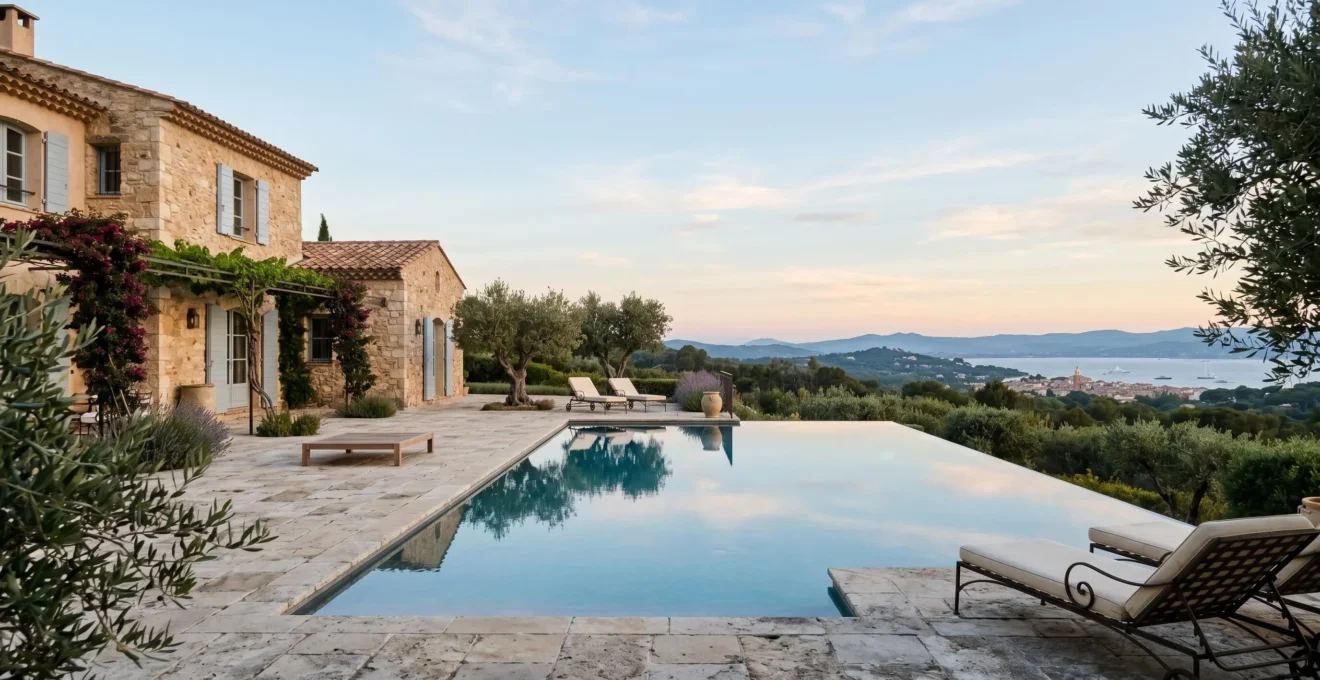
The concept of private guided visits also plays a role in the Riviera access ecosystem. As part of high-end travel planning, working with a specialist in visites guidées privées en France can open introductions to property networks that operate in parallel to standard real estate channels. Cultural and lifestyle networks on the Riviera are deeply intertwined with property access — particularly for clients arriving without existing local connections.
There is also a geographic dimension worth understanding. Saint-Tropez is not a single market. The peninsula encompasses distinct micro-territories — the village itself, the Pampelonne plateau, the Ramatuelle hillsides, the Gassin ridge — each with its own ownership profile and network density. An intermediary with genuine depth will distinguish between these zones rather than presenting all available inventory as equivalent. This specificity is itself a marker of credibility.
For those comparing approaches to exclusive coastal stays in France, the off-market dynamic operates similarly across other premium destinations. The logics applied to accessing villas de charme sur l’île de Ré — where secondary residence concentration is among the highest in France — mirror exactly what operates in the Var: network-first, platform-last.
Your next move before the season opens
- Identify one or two specialist concierge operators with documented Saint-Tropez portfolios — not aggregator platforms rebranded as exclusive
- Initiate contact a minimum of four to six months before the desired travel window to allow proper profile matching
- Prepare a clear, honest brief: number of guests, configuration needs, privacy requirements, dates and flexibility — ambiguity slows the matching process
- Ask explicitly whether properties presented are held under direct owner mandate or sourced through sub-referral networks
- Verify contractual terms independently: a genuine off-market operator will provide a formal rental agreement with owner-side documentation, not a platform-generated booking form
The most consequential decision in this process is not which property to choose — it is which operator to engage first. The quality of what gets surfaced depends entirely on the depth of the network behind the intermediary. Saint-Tropez‘s finest properties do not need to market themselves. The access infrastructure that surrounds them, however, is exactly what separates a genuinely exclusive stay from an expensive approximation of one.
How far in advance should a search for an off-market villa in Saint-Tropez begin?
For peak summer availability, the practice of the market suggests initiating contact with a specialist operator between four and six months before the intended stay. Properties held under exclusive mandate are often reserved through recurring client relationships before any new requests are entertained. Starting earlier does not guarantee access, but it opens the profiling window that makes proper matching possible.
Is there a meaningful difference between off-market rental and a standard luxury villa booking?
The difference is structural, not cosmetic. A publicly listed luxury villa — regardless of its quality — has been processed through aggregator systems, photographed for mass audiences and priced under competitive market pressure. An off-market property operates outside this cycle: its pricing, availability and client selection are managed privately. The experience gap often manifests in property condition, staff continuity and the level of discretion maintained throughout the stay.
What signals indicate that a claimed off-market operator actually has genuine network access?
A credible operator will be able to describe the ownership context of properties they present — family estate, corporate holding, private individual — without breaching confidentiality. They will facilitate access to property management contacts before commitment, not after. They will provide references from past clients of a comparable profile. And critically, they will maintain transparency about their exact position in the mandate chain: direct mandate from owner, or sub-referral from another agent.